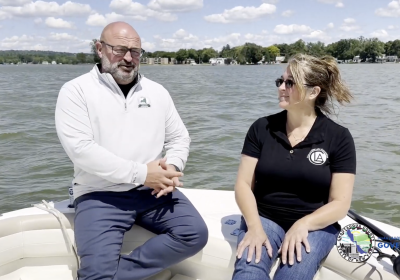
The Chautauqua Lake Association (CLA), a longstanding member of the New York State Federation of Lake Associations (NYSFOLA), participated in the 43rd annual conference, which was held on May 2–3, 2025, in Lake George, NY.
The conference began with a powerful message: “We are living with the choices and actions made years ago. Though we cannot change what has already been done, we can learn from it.” This sentiment aligns with the CLA’s mission and its decades of work to protect and maintain Chautauqua Lake.

On Saturday, CLA Executive Director Doug Conroe was honored to be a guest speaker at the conference. He presented on the CLA’s lake-wide operations, emphasizing the importance of the organization’s stewardship efforts, the scope of its programs, and the extensive inventory of equipment used each season. With one of the largest lake management fleets in New York State, Doug’s presentation prompted several thoughtful questions that opened the door for future discussions with other lake associations.
Conroe is widely recognized for his leadership in aquatic plant management and lake health initiatives. He served on the original Steering Committee that formed NYSFOLA in 1983 and was a member of its first board of directors from 1983 to 1984.
Below, CLA Executive Director Doug Conroe (DC) and Heather Nolan-Caskey (HN) share their notes from NYSOLA 2025:
HN: The Onondaga Earth Corps works with young adults to make a difference in local communities. Participants learn and assist hands-on with community and environmental needs. I connected with their stories and feel CLA offers a similar opportunity for young adults in our area. Much like Earth Corps, I share positive messages with our summer crews. This helps not only provide an enjoyable work environment and instills a sense of accomplishment for the good deeds they perform daily. Students shared their stories and journeys in a second session on this topic. This would be a meaningful way to promote our work in the future and could also be used for our hiring campaigns. This is also great to entice families and future generations into lake stewardship.
DC: During a session on mussels, it was noted that the invasive Zebra Mussels attach to hard surfaces like rocks and other native clams as well as aquatic plants such as eel grass. In contrast, Quagga Mussels settle in the soft lake bottom, similar to native clams. Quagga mussels are less desirable, and none have yet been found in Chautauqua Lake. However, they are present in nearby Lake Erie. This highlights the need for our Watercraft Steward program and measures like clean, drain & dry because these mussels can arrive in young microscopic forms.
HN: I attended several sessions focusing on Invasive Species and Harmful Algal Blooms (HAB) and heard stories about many small lakes in New York. Not all stories were positive and traditional methods did not always work. Many lakes are turning to the use of herbicides for control while others are experimenting with aeriation and direct current (DC) electricity. Many lakes reported higher water temperatures and increased HABS while others are dealing with new aquatic invasive species outbreaks. Despite the challenges, the repeated message was education and outreach are essential. This helps keep the community informed and involved, which can lead to better results. One suggestion was to offer hands-on training in identifying aquatic plants and harmful algal blooms. This could be a great addition to one of our events!
I learned an interesting fact about harmful algal blooms (HABs) and their causes. If HABs happen in areas with sandy soil or a sandy lake bottom, it is likely due to external loading from the watershed. However, if the soil or lake bottom has silt and muck, the HABs probably come from internal loading from the sediment. This understanding can help identify the cause and possible solutions.
Besides attending many informative sessions, this conference is a way to reconnect with other lake leaders. It reinforces the things we do and the way we do them. Often, we are asked questions and become a resource to other lakes. Overall, it is a valuable experience.
——
To learn more about the New York State Federation of Lake Associations: https://nysfola.org